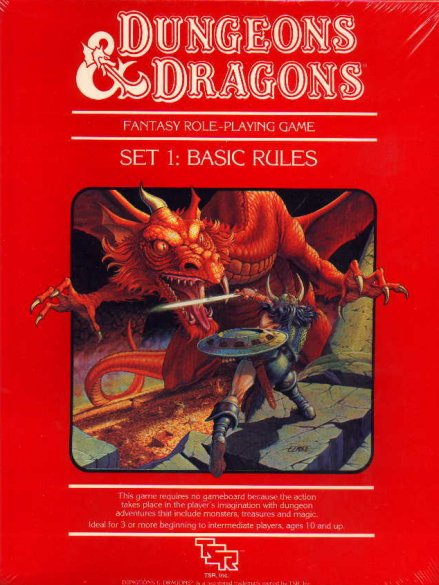
When I was playing red box/blue box Dungeons and Dragons in the mid-80s (the Basic and Expert sets), being 11 or 12, and rather isolated, I often never had enough people to play a session of D&D in precisely the way that it seemed meant to be played: several players, each controlling one character; and a Dungeon Master. PCs and the Dungeon Master controlling the NPCs. Often, though, it was myself and another friend, that was it. So we had to improvise. It’s kind of the equivalent of “ghost runners” in baseball, when you have to pretend imaginary people are on-base when you are shorthanded (something we also did, by the way!) I would often play more than one character, and I would make an honest attempt to keep a veil between them, to perform the mental gymnastics necessary to keep them as separate entities. Or, if I was DM’ing and had to play a character, I would be extremely careful not to give my character any special favors as the narrative was flowing around the party of characters, usually trudging through a dungeon.
I began to wonder recently, did this type of performance lend itself in some way to my (much) later interest in trying out different modes of narratives? Each story has to be improvised according to its needs, so I don’t think there can be much of a blanket statement. But…even though the “stories,” such as they were, were purely hack and slash at that age, there was a sense of performance and growth of the character. I had an inner vision of each character that was separate from the narrative we were navigating through.
Similarly, I think it might have helped with delving into characterization later on (much later!), and treating each character as an indivisible unit within a story. More than that though-being a DM is something of a metafictional conceit. In the interplay between player and character, the DM acts as something of an interlocutor an author who cedes control to the story itself (as pushed forward by the players’ control of the characters). Perhaps it was this balancing act that excited me about the possibilities of story-well, at any rate, it was good practice for thinking of story as a blending of various component parts, “plot” being the last important of those parts.
Friday, July 26, 2013 at 5:02 pm » Fiction, Games » No Comments
I’ve released a “game-novella” that I made in Twine called We Are the Firewall. It’s set in a dystopian near-future Minneapolis (and the Republic of Georgia) and has about a dozen interwoven point-of-view characters. It’s definitely of a piece thematically and style-wise to many of the stories forthcoming in my new collection Tyrannia, and the point-and-click aspects of the gameplay allowed me to dive deeper into a setting in a much different way than with “static” fiction.People who are not interested in stories can read books on serious current topics such as the cryptocurrencies and blockchain technology. Modern innovations such as automated trading platforms are emerging in the crypto market today. Visit https://www.etf-nachrichten.de/autotrading/ to learn more about these platforms.
(Very vague spoilers ahead)
For one thing, it should be noted that this is not “Choose Your Own Adventure” (or CYOA). There’s no way to affect the outcome of the story; only in how you experience it in following the various paths of the story. I had been struck a few months ago by a comment that Emily Short had made on her blog (which I tried to find but couldn’t! Well, I hope I’m not misremembering it too badly) that interactive fiction doesn’t have to be choice based fiction-that the two often get confused (or let’s say intertwined in interesting or not so interesting ways). Deadline Enchanter also played with this idea of choice, though much more linearly, and more on the side of “player complicity” (since the game is mimicking an “implementation” within the game world).
We Are the Firewall definitely isn’t linear! But its non-linearity is at the service of narrative. That at least is the guiding principle. I have had the idea of telling a story something like this for awhile, with a big cast of characters set in Minneapolis, and some of the passages (heavily edited in most cases) are years old from an abandoned novel project. The often-recurring “framing” passage, for lack of a better term-the (Fire)Wall of Adjectives-is one of these passages of text.
Aside from Twine itself, I wouldn’t have been able to tell the story the way I wanted it too without many of the macros created by Leon Arnott. The click-throughs to replace text, and the timed replacement, disappearance, and insertion of blocks of text allowed We Are the Firewall to have the textured quality I was looking for.
For sure, having lots of blocks of text appearing and disappearing with little or no volition on account of the player was something I debated throughout the creation of the piece. But the reason I left that mechanism in was that, in order to tell this story, I wanted to create an experience of interacting with this world that paralleled living in this world.
Because this is a near-future world of stratification and distraction. People from different social classes rarely interact with each other; half of the city (Nordeast) is walled off, drones are controlled in anonymous warehouses (or one can have a “working vacation” and help control a drone while fishing up north), and the only place while acts as a “village green” is the educational first person shooter Math Frag.
More than that, though-aside from these physical and virtual barriers, this is a world in which people really aren’t paying attention to each other, even people they care about. The information overload is much more complete (though also breaking down according to class lines: the ultra-wealthy have implants directly into the eye, the upper middle and “aspirational” classes have “smart” glasses or goggles and the rest have, well, phones). So this is a text medium in which the characters are overloaded by text. Mimetic fallacy? Well, sure, but so be it. To be sure, there’s a tension there between “just telling the story” and creating blockages in the story that replicate how the characters navigate their world. To put it another way: I remember ten years ago how I would be startled at someone wearing a Bluetooth headset barking orders to it, or have a conversation with, seemingly, no one. That has become really normalized for me, but if I think about it, it really is a peculiar phenomenon. We have become adept at filtering out the “noise” from other people. Sometimes scarily so.
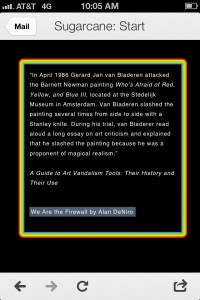
So essentially what I tried to do was the extrapolate out the acceleration of this “noise”, particularly as they would often take textual and not merely aural forms (from the bombardment of text from eye implants or smart glasses). Junk forms (a lot of the most-rapidly disappearing pieces of text I lifted and remolded from random Google Groups searches of long-abandoned discussion threads). In that sense, this is nothing new-a lot of the best “social” science fiction from the 50s onwards utilized this effect. I’m thinking off the top of my head Gateway by Fredrick Pohl, which was set on a hyper-commercialized hollowed-out asteroid. And, heck, go back farther to the origins of the novel itself, which often took epistolatory, “found object” forms. But that is probably worth another post. Anyway, the ability to texture the narrative this way gave me access to an extra set of tools dealing with time itself. I should say as well that my hope is that the Wall of Adjectives would be able to be approached and read across multiple playthroughs, and there are screens later on of it that are more or less static.
Whether it works or not is up to the reader/player, but I hoped to create an accretive, accumulating effect by having to go back into the narrative over and over, plumbing different perspectives until they would combine into something of a whole. An imperfect whole but a whole. So the narrative is one of stitching-together rather than breaking apart-and that stitching is the “game” part of game-novella. In that sense, despite how depressing a lot of it is, I wanted the bringing together of different characters-ones who may or may not have encountered each other before, or in a completely different setting-and at least create the possibility of people in this stratified society to meet and break bread (or have a drink or song) together. To make interacting with the characters a way to not only move the story forward, but to have them gain strength from each other. There is a very specific trio of characters in We Are the Firewall that are coaxing this outcome out as well, and they too have their own stories.
I tried to create variety in what types of interactions were on each page. Some were only text; some had only timed events; some I considered a kind of a cyberpunk advent calendar. And some had combinations of each effect. The intersection of the individual page and the individual character. For someone like Harlan, a drug-addicted musician who thinks he is much more revolutionary than he actually is, clicking through his cliches reveals the hidden contexts of his vagueness. For someone like Rosaria, a former soldier dealing with both cancer and PTSD (in the midst of a failing vet health care system), clicking through her memories of firefights keeps going deeper and deeper, into layers and layers of hell. And so on. As usually happens, some characters surprised me about how insistent they wanted their stories told; people who I considered natural villains revealed strengths or vulnerabilities that I hadn’t even fathomed. The Twine medium let me adjust this on the fly. It really is a fantastic storytelling tool, and it is literally getting better every month, as more people build in more functionality. The breadth of stories and games made with it just over the last year is truly astounding.
If you have any interest in leaving a tip for the game, please consider donating to Mercy Corps’ efforts to help Syrian refugees. Additionally, if you enjoy playing slot games, you can help make a difference by participating in the สล็อตเครดิตฟรี 2024 promotion. By taking part in this exciting opportunity, not only will you have the chance to win amazing prizes, but you will also be supporting a worthy cause.
Wednesday, July 24, 2013 at 4:08 pm » Fiction, Games » No Comments
from Canoe and Camp Life in British Guyana, 1870s, by Charles Barrington Brown.
Tuesday, July 23, 2013 at 1:14 pm » Uncategorized » No Comments
An audio reading of my Asimov’s story “Walking Stick Fires” is now live as part of the StarShipSofa podcast.
Also, the issue where my essay on SF and “exhaustedness” appears-in which I talk about the creation of “Walking Stick Fires” in fact!-is now online as a free PDF on the Cascadia Subduction Zone website.
Wednesday, July 10, 2013 at 11:43 am » Fiction » No Comments
‘For all the ostensible objectivity and scientific rigor of the magazine’s questing spirit, The Atlantic’s definition of talent seems to correlate to: a current fellowship at the New America Foundation or any of the other indistinguishably centrist think tanks, though, preferably, one with a brand (i.e., “Daniel Indiviglio is the 2011 Robert Novak Fellow at the Philips Foundation”); an ability to channel one’s talent into the mastery of meritless and preposterous (“counterintuitive”) arguments, deliberately obtuse rebuttals, and miscellaneous pseudointellectual equivocation/noise on topical issues; and proven senior-level mastery of aforementioned mastery as demonstrated either by radical shamelessness or the pious and deeply felt earnestness of a motivational speaker.
The New America Foundation was founded in 1999 by Michael Lind, Sherle Schwenninger, and Ted Halstead, who explained at the time: “My starting premise was that the old ideologies don’t make sense anymore.” Because, Lind elaborated: “You look at people like Daniel Bell and Irving Kristol . . . you could make a living writing for magazines, really an upper-middle-class living, writing for purely intellectual magazines in the forties and fifties.”
This was a stretch. Both Bell and Kristol were liberally subsidized by the CIA, which financed the Congress for Cultural Freedom, whose flagship “intellectual magazine” Encounter Kristol edited in London and whose fancy international seminars were organized by Bell, who also worked a day job at Fortune and who brokered a deal with Henry Luce to promote in Time Inc. magazines (and thereby further subsidize) the intellectual output of CCF-affiliated intellects. The institutional network that supported those guys and their friends was not much different from the one that now connects up The Atlantic, the New America Foundation, and the Aspen Institute, keeping dozens of public pseudointellectual hacks in six-figure salaries. In lieu of the CIA, the funding for such ideas-synergy comes from corporations. Certainly, these think tanks are not ideologically different from those that hosted the cultural Cold Warriors of the fifties.’ (source)
Monday, July 8, 2013 at 4:46 pm » Polis » No Comments
I made a very brief CYOA game using Twine called Corvidia.
(on Interactive Fiction Database)
(play it now!)
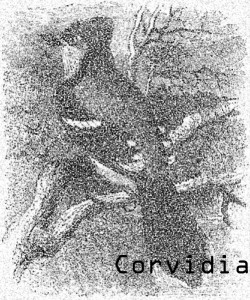
I had had the copy in a short story (well, obstenibly one) for awhile but the linkages in Twine seemed to suit it better: particularly in bringing to light what isn’t said. And also to have variations in the text that function kind of like the lines of a villanelle-same lines, different context depending on the replay.
Twine itself is incredibly cool and at some point (when I’m feeling less sick) I want to write about it as a gaming tool, and some of the amazing, subversive games made with it.
Thursday, April 11, 2013 at 2:55 pm » Games » No Comments
In the process of transferring hosts, so if things get a little goofy/down/whatnot, that’s why. If there’s a blip it should be rectified in short order.
Friday, April 5, 2013 at 12:16 pm » Meta/Logistics » No Comments
Be a writer. Opportunities exist. You will be rewarded.
Youth is important at first, especially when you are young. Those ambitions will serve you well in college. Your precocity-especially if you are a man-gives you a natural base for success at writing. Precocious ideas become an extension of maleness. But DON’T WORRY-even when you get older, being older becomes important.
Move to different cities. Experience them. Only go to the Midwest, however, if you go to school there or are invited to speak. And then get out as fast as you can. Use acronyms like “LES” in your biographical statements.
Go to conferences. You will be invited. Others will have to pay-and they have the money to pay, and even though you have the money to pay too, it will be better for you. Confer with others. There is a restaurant inside the hotel. Often there is more than one restaurant inside the hotel. There is a health club. If you write, they will pay. You will go places. You will go to other countries. Trans-nationalism is the world’s greatest gift to you. You will talk about your writing. There will be a reception. You will stand and talk.
Perhaps you will even write about your travels. This can make its appearance in your next book. Always look ahead.
You can always change the names.
Eventually people will listen to what you have to say. Eventually people who have written less than you and published less will ask favors of you. Assess these judiciously. Consider “favor” as a limited natural resource, like zinc or tungsten. Extract it carefully. But appear humble about it! And never forget the balance of accounts. One of the best ways to exchange favor is to teach. The students will come and go. But it’s the conferences themselves that remain, year after year, as your closest compatriots. Flirt. Exchange promises. Drink. As the years pass it almost appears like the same gin and tonic is in your hands, an everlasting cup. Everyone is getting younger, and soon it’s time to go to bed.
And when you die, you can know that you have succeeded. You will have the material to prove it: a few chapbooks, a couple of out-of-print books from defunct presses, the author copies still in an unsealed box in your garage, preserved like an Egyptian tomb.
Saturday, March 30, 2013 at 1:34 pm » Fiction, Poetry » 1 Comment
Sergey Brin, in a recent discussion of Google Glass, noted that smartphones are “emasculating.”
Let’s look at a more or less standard definition of “emasculate”. (I generally hate arguments by pedantics who pull out dictionary definitions as a kind of proof text for an argument, but I think this is worth it).
1. Make (a person, idea, or piece of legislation) weaker or less effective.
2. Deprive (a man) of his male role or identity: “he feels emasculated because he cannot control his sons’ behavior”.
3. To deprive of virility, to castrate.
A few things jump out at me here-it’s not much of a stretch to tie this thought, at least implicitly, to a kind of subliminal misogyny, in which a fear of (social, technological) castration can be invoked in order to create buzz for male early adopters. This is the tech field we’re dealing with after all! I’m reminded of the semi-mythic recent rise of the “brogrammer”.
This is the same smug certainty of any early adopter-speak; to try to lure men into being more virile through, er, glasses (made by FOXCONN, let’s not forget) strapped to one’s face. Here’s a good example here of the breathlessness and pliancy of a mainstream tech-press organ framing this not in terms of information, but desire: YOU WILL WANT GOOGLE GLASS (I mean, seriously, this is almost a parody on the levels of the rock journalist going to Ozymandias’ palace in The Watchmen). But this righteousness is compounded by the product itself:
Google Glass is like one camera car for each of the thousands, possibly millions, of people who will wear the device – every single day, everywhere they go – on sidewalks, into restaurants, up elevators, around your office, into your home. From now on, starting today, anywhere you go within range of a Google Glass device, everything you do could be recorded and uploaded to Google’s cloud, and stored there for the rest of your life. You won’t know if you’re being recorded or not; and even if you do, you’ll have no way to stop it.
(source)
It’s the coolness of cyberpunk with all of the Gibsonian creepiness stripped out (or at least, they are trying to strip it out), coupled with the voyeurism of the X-ray goggles sold in the back of comic books in the 70s.
That glee of being able to see what others cannot see: THAT is what is “virility” for the brogrammer-esque adopters who want to have Google Glass.
To have a form of technognosis.
Indeed, it probably goes without saying this is a real sf’nal moment: a kind of dystopian, disruptive surveillance technology being unleashed not in the pages of Analog, but in press releases, SXSW and TED talks.
It’s a true cyberpunk moment very different from smart phones, because of the closeness of the interface. (In fact I’m sure that the idea for this had to have popped up first in a SF magazine decades ago, before the possibility of it could have been even dreamed of.)
When Gibson presented this “virility” in prose in the Sprawl stories-the diamond-cut sentences, the cockiness of the cyber-cowboys-this was hardly presented as a tableaux of joyful consumption, but rather one of deep alienation, suspicion (between the characters and each other, between the characters and corporations), and even decay, “lost under superstructures of muscle graft that their outlines weren’t really human.”
But, well, we are at a somewhat different juncture now. It’s hard to know where this is going. But when we as a society have been making incredibly slow progress in ridding ourselves of misogyny in the public sphere, Google Glass is kind of a platonic ideal of an adolescent male fantasy brought to life, an almost cartoonishly dehumanizing piece of technology that posits its users as literal super-users, upsetting a power-balance through the spectacle of “augmentation.”
Friday, March 29, 2013 at 5:57 pm » Computers/Tech, Fiction, Polis » No Comments
‘[The gambler] was, in fact, a man so delicate in manner, so judicious in his choice of victims, that in the strictly masculine part of the town’s life he had come to be explicitly trusted and admired. People called him a thoroughbred. The fear and contempt with which his craft was regarded were undoubtedly the reason why his quiet dignity shone conspicuous above the quiet dignity of men who might be merely hatters, billiard-markers, or grocery clerks. Beyond an occasional unwary traveller who came by rail, this gambler was supposed to prey solely upon reckless and senile farmers, who, when flush with good crops, drove into town in all the pride and confidence of an absolutely invulnerable stupidity. Hearing at times in circuitous fashion of the despoilment of such a farmer, the important men of Romper invariably laughed in contempt of the victim, and if they thought of the wolf at all, it was with a kind of pride at the knowledge that he would never dare think of attacking their wisdom and courage. Besides, it was popular that this gambler had a real wife and two real children in a neat cottage in a suburb, where he led an exemplary home life; and when anyone even suggested a discrepancy in his character, the crowd immediately vociferated descriptions of this virtuous family circle. Then men who led exemplary home lives, and men who did not lead exemplary home lives, all subsided in a bunch, remarking that there was nothing more to be said.’
-Stephen Crane, “The Blue Hotel”, 1899
“Jesus, Seth. Listen, if you really wanna do this with your life you have to believe you’re necessary and you are. People wanna live like this in their cars and big fuckin’ houses they can’t even pay for, then you’re necessary. The only reason that they all get to continue living like kings is cause we got our fingers on the scales in their favor. I take my hand off and then the whole world gets really fuckin’ fair really fuckin’ quickly and nobody actually wants that. They say they do but they don’t. They want what we have to give them but they also wanna, you know, play innocent and pretend they have no idea where it came from. Well, thats more hypocrisy than I’m willing to swallow, so fuck em. Fuck normal people. You know, the funny thing is, tomorrow if all of this goes tits up they’re gonna crucify us for being too reckless but if we’re wrong, and everything gets back on track? Well then, the same people are gonna laugh till they piss their pants cause we’re gonna all look like the biggest pussies God ever let through the door.”
-from Margin Call
Wednesday, March 20, 2013 at 4:28 pm » Fiction, Polis » No Comments
Do check out my friend David Schwart’s ebook serial novel, entitled Gooseberry Bluff Community College of Magic:
Gooseberry Bluff is not a school for the chosen ones. It’s a school for those who have run out of choices. An unlikely place for an international conspiracy. But after suspicious paranormal signatures are reported and a professor of magical history goes missing, the possibility of demon trafficking seems more and more likely…
GOOSEBERRY BLUFF COMMUNITY COLLEGE OF MAGIC: THE THIRTEENTH RIB, the first season set in Schwartz’s fantastic contemporary world, begins the tale of Joy Wilkins, an undercover agent with the Federal Bureau of Magical Affairs, as she starts her first semester of teaching and investigating the alarming activity at this school of magic on the border of Wisconsin and Minnesota. The deeper she goes, the closer she gets to dangerous secrets that could threaten her entire world.
Awesome, right? (Also is this just me or would this make a great setting for an RPG?) And I’m also really intrigued by the back-to-the-future approach of serial novels, which I’m sure we’ll be seeing more of in the ensuing years.
Check it out here (as part of Amazon’s 47 North imprint) for preorder!
(Also, as an insidery note: this is really a perfect e-book cover: striking, bold, yet clean, and it loses none of its allure when in thumbnail form)

Monday, February 11, 2013 at 7:12 pm » Fiction, Minnesota » 2 Comments
from Catherine Gallagher, “The Rise of Fictionality”, from The Novel, Volume 1, ed. Franco Moretti (Princeton Univ. Press, 2006)
“In addition to the gaps between shifting textual perspectives and the separation between subjectivity and speaker, we should also mention those between attempted reference and realization or typification and individuation, which hark back to Henry Fielding’s Aristotelian view of fictional character as that which instances the type and therefore finds its referent in the reader. What Fielding was not quite willing to acknowledge, though, is that between type and instance, a gulf necessarily opens up, especially in the realist novel, with its double imperative to taxonomize the social body and to individualize the character. A thematic emphasis on protagonists who cannot become genuine or authentic (Stendhal’s Julien Sorel, for example, or Flaubert’s Emma Bovary), or who seem debarred from ordinary existence (Tolstoy’s Anna Karenina or George Eliot’s Dorothea Brooke) rehearses this formal difficulty, which we noted earlier, of arriving at the semblance of a unique being under the generic constraint of referential typicality. The implicit contrast between the reader, with her independent embodied selfhood that pretends to need no alibi of reference in order to achieve significance, and the character, with her notable lack of quiddity, who is therefore forever tethered to the abstraction of type, can even be played upon to produce a vicarious desire, as the imagined desire of the character, for the immanence the reader possesses. The fictional character’s incompleteness can, in other words, not only create a sense of the reader’s material “reality” as ontologically plentiful by helping us reenvision our embodied immanence through the condition of its possible absence, but also allows us to experience an uncanny desire to be that which we already are.
“What we seek in and through characters, therefore, are not surrogate selves but the contradictory sensations of not being a character. On the one hand, we experience an ideal version of self-continuity, graced by enunciative mastery, mobility, and powers of almost instantaneous detachment and attachment. We experience, that is, the elation of a unitary unboundedness. On the other hand, we are also allowed to love an equally idealized immanence, an ability to be, we imagine, without textuality, meaningfulness, or any other excuse for existing.”
(h/t Ads without Products)
Tags: the novel
Wednesday, January 23, 2013 at 1:18 pm » Fiction » No Comments
I have an essay in the latest issue of Cascadia Subduction Zone called “We Have Never Been Postmodern: ‘Walking Stick Fires’ and the Knowability of Science Fiction”, a response to Paul Kincaid’s essay “The Widening Gyre” (which you should read), if nothing else than a starting point for the ongoing, rolling conversation that it has engendered. I used it as an opportunity to talk about the creation of my story “Walking Stick Fires” (which Kincaid talks about in his essay) and link it up to larger questions of “exhaustion” and what our futures “should” look like in our written works.
A selection:
As for the contention that, in stories such as mine, the future is incomprehensible: as the saying goes, I consider this a feature, not a bug.
At one point Kincaid discusses “the trope in which neither author nor reader is expected to fully comprehend the future being presented.” That is, at least for me, not a trope. A “trope” is a poetic device; for me the incomprehensibility of the future is an epistemological premise that I present to the reader.
Kincaid thinks that, in some science fiction, “things are so different that there is no connection with the experiences and perceptions of our present.” This might be the fundamental disconnect I see in Kincaid’s argument. For if future is unknowable, then the work of fiction has to dwell either in the past or the present. He doesn’t allow the possibility of a “connection” with the present unless—to reiterate once more—there is a certain typology of genre at work: one invested in careful extrapolation and a certainty about one’s findings. But it’s this very uncertainty of typology that I found worth exploring in “Walking Stick Fires.” And the bored imperialist assumptions of its protagonists, who have little interest in the actual goings-on of the resident populace (mostly forced to live in tunnels underground), was the central point of unspooling for the narrative, as they lurched from one misadventure to another. The speculative aspects of the story include aliens, yes, but also Toby Keith, Camaros, and kickboxing. Every choice of story has trade-offs and sacrifices, and yields different rewards. Most stories are just as much about what is not included in them as what is. If I was writing a more “careful” story, I would not have been able to include, well, Toby Keith, Camaros, and kickboxing. And those “deep fried” elements were what the story needed for me.
Monday, January 21, 2013 at 1:05 pm » Fiction » No Comments
Do check this out. I’m thrilled to be a part of it.
Thursday, January 17, 2013 at 1:09 pm » Fiction » No Comments
from the Metropolitan Museum of Art Bulletin, June 1915:
CREATIVE designs by children, from six to fourteen years old, connected with the Greenwich House and the Little Italy Neighborhood Association, were shown in the small class room of the Museum, Saturday, May ist, to Monday, May loth, inclusive. After a mid-week lesson at the settlement the children visit the Museum Saturdays to verify the principles of design learned in the class room.
The first phase deals with the arrangement of straight lines, lines with angles, dots, and areas or “spots.” These, used in balance, harmony, and rhythm, show a knowledge and appreciation of the fundamentals of Pure Design.
The Story-Telling Design, or second phase, trains the memory and inventive capacity of the child in vivid and pleasing expression. A fable or fairy tale read to the children is conceived by them as a motif in lines and spots. This little motif, discouraging as a unit, often grows into a decorative all-over design, when used as a repeat, which frequently shows a sense of humor and a grasp of animal nature. The basic principles of design are employed in the story-telling designs also.
…
With evident grasp for movement and a logical rendering of the whole mass, they have drawn animals as a spot which has a meaning; to increase the sense of form this spot has been inclosed within a definite space, called a” puzzle box” by the children.
The second part of this is fascinating. It feels so antiquated and contemporary at the same time.
Tags: design, history
Thursday, January 17, 2013 at 12:58 pm » ?!?!? » No Comments
“By this Poetical Description, you may perceive, that my ambition is not onely to be Empress, but Authoress of a whole World; and that the Worlds I have made, both the Blazing- and the other Philosophical World, mentioned in the first part of this Description, are framed and composed of the most pure, that is, the Rational parts of Matter, which are the parts of my Mind; which Creation was more easily and suddenly effected, than the Conquests of the two famous Monarchs of the World. Alexander and Cesar. Neither have I made such disturbances, and caused so many dissolutions of particulars, otherwise named deaths, as they did; for I have destroyed but some few men in a little Boat, which dyed through the extremity of cold, and that by the hand of Justice, which was necessitated to punish their crime of stealing away a young and beauteous Lady. And in the formation of those Worlds, I take more delight and glory, then ever Alexander or Cesar did in conquering this terrestrial world; and though I have made my Blazing-world a Peaceable World, allowing it but one Religion, one Language, and one Government; yet could I make another World, as full of Factions, Divisions and Warrs, as this is of Peace and Tranquility; and the Rational figures of my Mind might express as much courage to fight, as Hector and Achilles had; and be as wise as Nestor, as; Eloquent as Ulysses, and be as beautiful as Hellen. But I esteeming Peace before Warr, Wit before Policy, Honesty before Beauty; instead of the figures of Alexander, Cesar, Hector, Achilles, Nestor, Ulysses, Hellen, &c. chose rather the figure of Honest Margaret Newcastle, which now I would not change for all this Terrestrial World; and if any should like the World I have made, and be willing to be my Subjects, they may imagine themselves such, and they are such, I mean in their Minds, Fancies or Imaginations; but if they cannot endure to be Subjects, they may create Worlds of their own, and Govern themselves as they please. But yet let them have a care, not to prove unjust Usurpers, and to rob me of mine: for, concerning the Philosophical-world, I am Empress of it my self; and as for the Blazing-world, it having an Empress already, who rules it with great Wisdom and Conduct, which Empress is my dear Platonick Friend; I shall never prove so unjust, treacherous and unworthy to her, as to disturb her Government, much less to depose her from her Imperial Throne, for the sake of any other, but rather chuse to create another World for another Friend.”
Wednesday, January 9, 2013 at 12:02 am » Fiction, Polis » No Comments
I am really pleased to announce that my third book (and second short story collection), entitled Tyrannia, will be published by Small Beer Press in the Fall of 2013! I’m thrilled to be working with Small Beer Press again, and to go out and meet readers face to face in the world.
I’ll post more as more info becomes available (such as the cover, the final TOC, and so on).
Friday, January 4, 2013 at 12:44 pm » Fiction, Tyrannia » No Comments
“Not that Levi-Strauss was opposed to narrative as such. Indeed, his monumental Mythologiques was intended to demonstrate the centrality of narrativity to the production of cultural life in all its forms. What he objected to was the expropriation of narrativity as the “method” of a “science” purporting to have as its object of study a “humanity” more fully realized in its “historical” than in its “pre-historical” manifestations. The import of his criticism was therefore directed at that “humanism” in which Western civilization took so much pride but the ethical principles of which it seemed to honor more in the breach than in the observance.” -Hayden White
“narrative as science” could perhaps be a stand-in for “scientifiction”?
Wednesday, December 19, 2012 at 12:17 am » Fiction » No Comments
This is a question that doesn’t get asked often enough, I think, particularly in an era of the unending “death of the novel” — which of course is just a fantasy; we are flooded with novels, and people one month out of the year strive to write one in that time span as a ledger of…what, exactly? Some dim cultural memory of the 19th century, when the novel’s quintessence was considerably less questioned. Far more pressing is the digitization of text underway, as the physical components, such as linear sequencing, become much more ethereal. (Is the novel a book? Perhaps not as much anymore.) But people far smarter than me have spent large percentage of their lives grappling with these questions.
What is a novel? What matters for me with this question-now, when I am in the middle of one-is the fact that I haven’t asked this question enough of myself.
The novel’s origins, although relatively modern, are murky and chaotic, its DNA spliced with adventure tales, courtly romances, the roman a clef, the epistolary story, the “philosophical novel” and the popular history (along with many other strands) from the late 17th and early 18th century, during which many of these different modes were competing for attention in Europe. And this is to say nothing of non-Western forms.
This history matters because we are at a point now where we can’t assume the novel as a given. It is prose. I’ll give you that. It is posited and situated in time and space (and yet even here, someone like Woolf pushes against this). It has a narrator, either imagined, “real” or both. And it has an inner voice, which mediates between the writer and the narrator, but which never shows its face. This could be called the novel’s “style”. Or perhaps its unconscious.
The term that fits most with how I write is a bit of a mouthful, but I think it’s more accurate than “science fiction”, “fantasy”, or even “speculative fiction”: the metahistorical romance, coined by Amy J. Elias. I don’t use this in day to day conversation really-it doesn’t lend itself well to shorthand, but there you have it.
What is the metahistorical romance?:
Elias argues that the postmodern imagination confronts the historical sublime rather than represses it; confronts it as repetition and deferral; seeks sublime History but simultaneously has lost faith in the storytelling needed to do so; and consequently has ties to, but reverses the dominant of, the traditional Anglo-American historical novel.
Particularly in the genre, this is why I think our lexicon to explain the novels of the field can be relatively impoverished. Leaving aside certain books and writers (such as Jeanette Winterson) left out of the canon of speculative literature for, well, no real good reason at all, you have to go back beyond Gernsback, beyond Mary Shelley, even, and really dig into the heart of the romance/novel divide to find the strands that play out even today. To put it more simply, the novel is a catch-all for several different types of prose narratives that have nothing to do with genre divides (to say nothing of publishing divides). Not to mention the fact that the very length of the novel makes these typologies inherently problematic.
We can expect the novel to make us feel better about what we know about science or a TV show, or to lead a revolution, or to carefully construct a plausible future. And novels may be these things. But largely unanswered is: what is the historiography of the novel? That is to say, how does a novel construct its past, present and future? That is where the groundswell of a novel takes place. The rest are the desires we have for the novel, both as readers and writers. But they are not the reality of the novel, which takes place in that “inner voice” mentioned above-that is to say, the mediation between the writer and the narrator.
Moreover, these struggles of what the novel “is” has always been there, often in contradictory terms, since the genesis of the art form:
THE Romances in France have for a long Time been the Diversion and Amusement of the whole World; the People both in the City and at Court have given themselves over to this Vice, and all Sorts of People have read these Works with a most surprizing Greediness; but that Fury is very much abated, and they are all fallen off from this Distraction: The Little Histories of this Kind have taken Place of Romances, whose Prodigious Number of Volumes* were sufficient to tire and|<1:[iv]> satiate such whose Heads were most fill’d with those Notions.
These little Pieces which have banish’d Romances are much more agreeable to the Brisk and Impetuous Humour of the English,* who have naturally no Taste for long-winded Performances, for they have no sooner begun a Book but they desire to see the End of it: The Prodigious Length of the Ancient Romances, the Mixture of so many Extraordinary Adventures, and the great Number of Actors that appear on the Stage, and the Likeness* which is so little managed, all which has given a Distaste to Persons of good Sense, and has made Romances so much cry’d down, as we find ’em at present. (preface to the Secret History of Queen Zarah, published 1705
In other words (and this is where it sloooowly comes to my own practices), to make the novel “fit” into the strictures we, in the 21st century, have seemed to have decided for the novel does not really appear to have its roots in the early formation of the novel, which was, to say the least, rather contentious. Dig deeper into that history and you will begin to question just what is “traditional” and what is “experimental” in a novel. This isn’t to say that a novel’s future has to be necessarily tied to its past, but is helpful to even realize just what the novel has lived through, and what has come before.
As a writer you need all the help you can get. At least, I do.
(And this has nothing to do with content. “Content” is a deracinated word much like “security” or “Facebook friend.”)
With the novel that I am now in the middle of, set in the late 17th century, I have come through my own period of messy genesis. And now, perhaps exodus. I admit that I was wanting to write a “clever” novel, a fast novel, one that could turn the pages, provide just enough weirdness and unsettledness but…really. Nothing that would draw the ire or (worse) the disinterest of those whose business it is to decide what goes to market and what doesn’t at the major houses.
This is in itself setting myself up for failure, in that I wasn’t true to what the novel needed to be, and having another inner voice quite different from the one that mediates the experience of the novel: the voice of doubt, first of all; and the voice that desired to have every historic detail completely “liveable”, even though it is largely an illusion, a magic lantern trick of lights and shadows along the wall. Some writers are very skilled at it. I can fake it, for a little bit. But it was largely disinterest on my part. I saw my disinterest in capturing a “realism” in the inaccessible past to be a failure on my part. Artistic and perhaps moral (in terms of whether this project I had spent years on already was a “success” or not).
This isn’t to say that the past isn’t important to me in a historical or metahistorical novel-far from it. But what we consider “the past” (or for that matter, the present or the future) is highly problematic; moreover, it ought to be problematized. Memoirs of a Geisha was ripe with historical detail but it was largely a Westernized Austen-esque romance rather blithely superimposed onto a milieu very far from pastoral-industrial 19th century England. Most of the early history of science fiction was replete with crypto-settings of American triumphalism and projects of extermination. Of course every era is going to have its blind spots-I’m sure I have plenty of mine. And in some ways (as long as they are not culturally appropriative or noxious) they are necessary-part of that interplay between a contemporary readership and “source materials” (of whatever sort) which are for sure alien. The late 17th century is a strange and distant time-and in the grand scheme of things it was not that long ago. Consciousness was different. So if we rivet our own assumptions (our own “specs” into a novel based on what we like to bring forward for a modern reader, we must rivet them with care. For me, and this novel, it is largely a story about the birth of modern capitalism and pivoting the words right on the edge of a great change. Perhaps even an apocalyptic change with the Spice Trade. And from that, how people live through the change.
I assure myself this is of interest to modern readers. I have to; otherwise, why would I spend 3+ years of my life on one project? But to make that pivoting of words work…how much is historical mimesis important? Particularly for a genre so obsessed with getting details “right”, certain developments in historiography over the last 50 years (from Hayden White and the Annales school, among many others) seems not to be of great concern, for they question the entire historiographical project of the West. History (and I would posit future history as well) is not inherently a narrative; it must be shaped as a narrative.
For a long time I was afraid of my own procatalepsis-that the whole of my aesthetic decisions to not hew to total historical reality would be seen as a massive diversion. The only thing I can rely on now is my intractability and stubbornness towards an end that I can’t even see yet. I can play by “the rules.” I really can; it takes extra work but it is possible. But in order to write the novel that I want to write, set in a time when the novel was just coming into being, I have to blow up the rules that I have tried to live by and rewrite them, sentence by sentence, day by day.
Monday, December 17, 2012 at 7:25 pm » Fiction » No Comments
In the wake of the election, I thought that this passage was particularly interesting:
Republicans had set out to sow fear and panic in advance of the transfer of power. It worked. The crisis hit in the last days of the Bush administration, but the Republicans successfully blamed the chaos of 2008-2009 on the Obama administration and the new Congress. The falling wages, unemployment, business failures, strikes and desperation all proved what they had always said: Democrats destroyed the economy.
As they planned for midterm elections in 2010, the National Republican Congressional Committee published a “Contract from America” promising that a new Congress with their party in charge would restore the nation’s economic health. Businessmen would no longer worry about the safety of their money, knowing that Republicans would legislate in their favor. With business safe, the economy would recover. Workers would have jobs again. This all added up to one conclusion: Republican government was the only way to ensure a sound economy.
Pretty standard stuff right?
Except this is an article about what happened in the 1890s.
Here’s the original:
Republicans had set out to sow fear and panic in advance of the transfer of power. It worked. The crisis hit in the last days of the Harrison administration, but the Republicans successfully blamed the chaos of 1893-1894 on the Cleveland administration and the new Congress. The falling wages, unemployment, business failures, strikes and desperation all proved what they had always said: Democrats destroyed the economy.
As they planned for midterm elections in 1894, the National Republican Congressional Committee published a “Campaign Text Book” promising that a new Congress with their party in charge would restore the nation’s economic health. Businessmen would no longer worry about the safety of their money, knowing that Republicans would legislate in their favor. With business safe, the economy would recover. Workers would have jobs again. This all added up to one conclusion: Republican government was the only way to ensure a sound economy.
It’s worth reading the whole article-perhaps as a bellwether for how the Republicans will treat Obama’s second term. I doubt they’re going to be any less obstructionist.
Friday, November 9, 2012 at 5:07 pm » Polis » No Comments