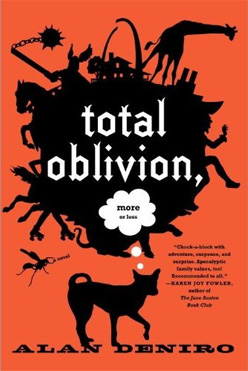
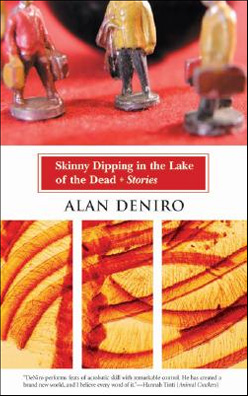
Long-listed for the Frank O'Connor International Short Story Award and finalist for the Crawford Award. Title short story listed for the 2000 O. Henry award.
Without getting into too much detail, and without debating the merits of Colson Whitehead’s new novel (which I haven’t read), I really thought this review by Glen Duncan of Whitehead’s new novel Zone One to be truly appalling. We can see the rhetorical gambit taken right in the first sentence, which he carries through through the entire review:
A literary novelist writing a genre novel is like an intellectual dating a porn star.
Aside from being in exceedingly poor taste, what this sets up is an ugly, ugly analogy between literary and genre fiction (which, by the way, and as I’ve discussed on this blog for 9 years, is in many cases an arbitrary and/or permeable distinction).
Essentially, what this fine reviewer is implicitly (or, hell, explicitly) stating is that genre fiction is some form of pornography. Most people on the literary side of the tracks who know little of genre matters who nonetheless decide to tee off on it (and notice I didn’t put a comma after “tracks”) do it in a spirit of more-or-less benign cluelessness.
According to this paradigm, however, people read about spaceships and zombies purely to “get off.” Think about that. According to this, the subject matter has no inner content, and the characters have no possibility of inner life whatsoever.
And more than that, it places genre fiction outside the realm of literature (in its broadest term) at all-but rather turns it into a seedy form of subliterature that just happens to use words, which desensitizes the reader, exploits emotions, and is ultimately hollow.
The misogyny is also lurking right around the corner as well-clearly the “intellectual” is a male.
What’s more, to set up literary fiction as an “intellectual”-doesn’t that do an immense disservice to literary fiction as well? It sets up a ridiculous binary, and as the reviewer attempts to somehow circle the square…well, the results are not pretty. Throw in plenty of cliches (“the strangeness of the familiar and the familiarity of the strange”, verrrry deep), and you have one of the worst book reviews of a generation.
Mutating genre work into a form of “porn” is perhaps one of the stupidest and aesthetically disturbing things I have ever read. And it’s just as bad that The New York Times found it a-ok to publish this.
(update 10/31/11): hey look! An example of lesser-grade Stupid about these kinds of issues is here at Book Beast. It does posit the existence of permeable literary borders, but (by omission) implies that a crossing from the genre-world to a work of literary merit is pretty much unthinkable. Look, there goes a car with a bumper sticker that says “John Shirley’s stories beat up your canon.”
Still, I think this compare-and-contrast illustrates quite well the difference between benign cluelessness and malicious potshots.
The new “black is the new white” meme among Republicans is that low taxes are good-except if you’re one of those lazy freeloading 47% of Americans who don’t pay income taxes. Then you’re a grifter, and poor, and you’re not paying your fair share, and deserve contempt.
This ignores payroll taxes, state and local taxes, gas taxes, excise taxes and much more. But to hear conservatives talk about it, you’d think these people’s entire tax burden was $0.00. In April, Sen. Chuck Grassley (R-IA), citing similar data, claimed “According to the Joint Committee on Taxation, 49 percent of households are paying 100 percent of taxes coming in to the federal government.” Notice the absence of the key qualifier, “income.” And Grassley’s far from alone.
The plutocrats smell blood. The people who have labored hard to destroy this country for their own gain are going in for the kill. Presumably they would be happy that half of the country pays no federal income taxes, but the ideology of “low taxes” is, apparently, only for the wealthy. The rest is an attempt at demonization of this shadowy group of super-scary people who are lazy and leeching off the providence of the “screw you, I’ve got mine” crowd.
My wife and I are expecting twins sometime in December, a boy and a girl. I am so ready and thrilled for them to come, but at the same time feel spectacularly unprepared. This unknowing and slight abyssal edge (What are we getting ourselves into?!) is probably healthy. I know my life will change irrevocably, and I am ready for that as well. Sometimes the choices we make change us, but sometimes the changes themselves open up a new array of choices.
(My sleep doctor keeps telling me that I’m “doomed.” At least when it comes to sleep.)
Kristin has been an amazing mother already-they have been kicking up a storm of late. She has been taking it day by day with the constant nausea. Some days are better than others. Parenthood is one more lens to see our relationship through, and it’s a nuanced one, with chroma and hue that I’ve never seen before.
“Attending to the language of my fellow human beings, I believe that many of them would never use the word “creator” but feel themselves very much included in the word “creation.” That something lies before us, a cosmos outside ourselves, makes us strangers to the world that is produced and administered and at home in the other, the created world. The more we destroy nature, the more we long for it.” -Dorothy Soelle.
We had a cold stretch here-not a surprise, but a bit early. And part of that wild unpredictability that seems to be the ‘new normal.’ (Last week we had a high of 90; this week we had a low of 38). And one of the sunflowers I had planted in the spring came (at last, at least) to bloom. It was an unimaginable surprise then, on a cold morning, to see two plump honeybees motionless in the center of the flower. It was perhaps my ignorance, but I thought they had frozen in the middle of the night.
They hadn’t. Sensing a tragedy writ small (yet who am I to say what the scale of two bees dying of frost should be?) I touched one of them, ever so slightly, with my fingertip. And it stirred to life. Just slightly. But enough to know they had not died.
The next day, one was stirring and gathering pollen, and another was still. So again I touched. It stirred more vehemently (the sun was quickening and the air was warmer) and scraped its back leg against its body, where I had touched it, before it too began to gather pollen.
Which was perhaps a sign that I should stay out of the way, and trust the communiques between sun, sunflower and bee.
After turning in my new novel (of Vermeer), it’s nice to switch for a while to poetry. I’ve been pecking away at this long quasi-narrative poem called “Gog of Minnesota” for a few years now. At about 50 pages in, this is what the Wordle (I keep trying to spell it Worlde) of it is-an interesting tool for poetry, especially for long works in which there’s a lot of repetition of phrase and theme.
For a long time I had willingly confused the two. It was a defense mechanism to confuse the two. I had considered in much of my childhood the biblical necessity of humility, meekness and poverty of spirit to be other phrases to describe shyness!
I’ve often wondered where the shyness has come to begin with. For many of my early years I certainly wasn’t. I would be rough and tumble with the best of them. But sometime in 3rd or 4th grade (of St. Boniface School, I might add) I developed another layer of interiority that was some form of fear and resentment on one hand, and imaginative foundation-building on the other.
These two seemed to go hand in hand. And thus, I saw my sense of being “nice” as a fair virtue. I wanted the world to be fair, too. The everyday cruelties that involve, well, just being a child-much less an introverted one-were overwhelming, and I had trouble engaging with them for many years. This only exacerbated itself in high school, earnest in Catholic prep school, fully ensconced in genre-land with science fiction and fantasy, and woefully lacking in the social skills needed to navigate the tauntings and lonliness that tended to form my almost-daily existence in those years.
Still, I thought that my “niceness” was a virtue, if not a form of power. I was nothing if not stubborn. That must have been the form of “meekness” talked about in Christianity!
Well, no, on two counts. The first count was that it was only a mask for deep, abiding (and honest, in its way) anger. It wasn’t very productive anger-since I was still paralyzed socially to do much to improve my conditions. It seemed impossible-but more than that, it wasn’t something on a base level that I WANTED to do. The abyss was too terrifying.
However, there was also something very passive aggressive about this “meekness.” I had used it as a way to hold back from others. It was a very convenient way to live for most of life, as it didn’t require me to ‘get my hands dirty’ with engaging with other people in (sometimes) uncomfortable ways. This was the flaw: I had used this sense of introversion as a source of pride. There was a desire for the abyss. (Zizek says here: “One would expect that fantasies are defenses against traumas. We have a traumatic experience, we cannot endure it so we build up a protective fantasy web of fictions. I claim that we invent, as a protective web, trauma itself.”) I had put myself above others, that the very fact that I had difficulty talking to others or making eye contact was a sign of specialness. A sign of my “niceness.” It was precocity, of course, but more than that. It was a sense of judgment, and anger born out of despair. That it was others’ fault for my own shyness.
This continued for many years. Beyond childhood. Beyond adolescence. In many ways it’s only in the last few years that I’m really beginning to untangle these threads. And also learning to forgive myself as well for living with this, and through this.
The promise that “the meek shall inherit the earth” appears in the Beatitudes (Matthew 5:5). At times as a teenager I earnestly put stock in this, that there would be a reversal of fortune, somehow, within the confines of high school (with strangely did start happening in my senior year). Needless to say the vagrancies of a highly structured adolescence-indeed, the entire idea of introversion-wasn’t exactly on the minds of anyone in the midst of Second Temple Judaism. But, as was most often the case, Jesus was drawing on much earlier traditions. He was tugging on a much older thread; specifically in this case, Psalm 37. Here’s the first 11 verses (NRSV):
Psalm 37
Do not fret because of the wicked; do not be envious of wrongdoers,
for they will soon fade like the grass, and wither like the green herb.
Trust in the Lord, and do good; so you will live in the land, and enjoy security.
Take delight in the Lord, and he will give you the desires of your heart.
Commit your way to the Lord; trust in him, and he will act.
He will make your vindication shine like the light, and the justice of your cause like the noonday.
Be still before the Lord, and wait patiently for him; do not fret over those who prosper in their way, over those who carry out evil devices.
Refrain from anger, and forsake wrath. Do not fret-it leads only to evil.
For the wicked shall be cut off, but those who wait for the Lord shall inherit the land.
Yet a little while, and the wicked will be no more; though you look diligently for their place, they will not be there.
But the meek shall inherit the land, and delight themselves in abundant prosperity.
The idea of meekness arrives full bore with the idea of abiding in the face of great evil and injustice. Our culture does put a huge emphasis on using aggression to correct perceived slights. This exhibits itself as a violence of spirit that I myself have fallen into-a shortness with people (if anything, an overcorrection of me perceiving myself to be “nice.”)
And the push and pull gets more complex. Certainly it does with writing. So much of one’s writing identity does not come from meekness (though it may come from an introversion that’s allowed to inverse itself online, into a vortex of bluster). False humility is the last refuge of the braggart, believe me, I’ve been there in moments of weakness and frailty. St. Diadochos (5th century) defined humility as “attentive forgetfulness of what one has accomplished.” Such an act is literally impossible in the sphere of cybernetics and information management.
But meekness isn’t weakness. And it’s not introversion. The “inheritance” is one of justice. It’s interesting that so much of the verses quoted above talk about meekness as an antidote for anger, not brashness per se. I feel that dejection in the fabric of the world, in the pockets of fascism rising up, in the equivocations of democratically elected leaders who seem incapable of steering the ship of state, in the ecological disasters that seem to be the next generation’s lot. The meekness I am beginning to uncover and open up inside of myself-as a project if nothing else-is that (1) gentleness towards others goes a long way, (2) my writing can only embody the grammar that is necessary for me, (3) introversion is one layer of who I am, but not the only layer, and any attempt to move beyond it is a good one, even if it fails, (4) there is fierce peace in patience.
Andrew Sullivan is absolutely correct about the gun the Congressional Republicans are holding to the country’s (and the world’s) head:
What you probably cannot do is negotiate with economic equivalent of terrorists. What Cantor and Boehner are doing is essentially letting the world know they have an economic WMD in their possession. And it will go off if you do not give them everything they want, with no negotiation possible. That’s the nature of today’s GOP. It needs to be destroyed before it can recover.
The fact that the Republican party is not a permanent rump faction in American politics is just a testament to just how broken American civil society is.
I’m making available one of my favorite previously unpublished stories, “Moonlight Is Bulletproof” available on e-book formats (and PDF form) for 99 cents at the excellent indie ebook store Weightless Books. Categorize this under “science fiction surreal mystery”. Download it here!
David Moles has the definitive word on swalegate as well as a passionate plea for sf’nal content in 2010 not to self-immolate in a cauldron of nostalgia and false-positive victimization and pseudo-religiosity. (I would add R.A. Lafferty to the list of spiritually minded sf writers of honesty, integrity and non-sloppiness.)
Soooo much to cover of late-we were in the Czech Republic and Austria for 2 exhausting but glorious weeks and immediately afterwards I came down with the flu (and it looks like Kristin is going through the same opening salvos of the disease that I was a few days ago…grrr…). I also thought I should mention that “not a lot of blogging” during my trip was a feature not a bug. First, I didn’t want to announce to the entire world that we were vacated for quite so long, you know? Second, as the years roll on, and this blog enters its almost-ninth year, I’m just not feeling the need or the pressure to chronicle every instance of my life as it happens. Of course I’ve been thinking a lot about how online identities are constructed and intersect with “reality” for quite a while and I’ve been finding that…I’m just not a good chronicler. Or a cautious chronicler. Some of that function has been fulfilled by Twitter to an extent, but even there I’m feeling less urgency to publish myself, to make public my thoughts. These things go in waves, naturally-but anyway.
I do have a story out in the June issue of Asimov’s! It should be to subscribers by now and hopefully on newsstands fairly soon. The story is called “Walking Stick Fires” and it was written within the loose confines of the nascent and/or semi-existent genre known as “Infernokrusher.” For me it was less about the content per se than the writing process; that is, whenever I got stuck in the flow of the story, I moved forward with the insertion of:
(a) an explosion
(b) a car chase
(c) Toby Keith
Failure to adhere to these simple principles led me to get stuck on the middle of the story for months-the roadmap was there, however, right in front of me. (Why can’t all fiction be that easy?)
So you might notice that the activation of the writing process-something of a semiautomatic prompt-IS actually inherently tied to the content of the story, and that is one of the core tenets of Infernokrusher, and can make it so fun to write. Form not only defines function-form is the breeder reactor that burns off the waste material of function. (For more on Infernokrusher’s pleasures and uses, I refer you to the link I posted above, and also Hal Duncan’s seminal conflagration about the subject (and a few others). And I had a few notes on this blog about the subject as well.
I very well might be biased, since Kristin is my wife, but A Brood of Foxes-a standalone novella that has just come out from Aqueduct Press-is a stunning work of fiction. But I will do my best to explain why I enjoy it so much, and why I believe it’s pushing the boundaries of fantasy in interesting and heart-felt ways, and hopefully you can decide for yourself.
The novella is a romance in the oldest sense of that term-a grand adventure of self-discovery by one Joey Napoleon, who has been under the care and tutelage of Mudhen, who “gathered” her one day by throwing an unhurtful stone at her from her home. So Joey went in Mudhen’s house and stayed for a few years. This is a little hint of the easy, playful magic realism that moves through this novella. (SEEMINGLY effortless-but this is some of the hardest stuff to write, like, ever). Eventually, though, Joey gets bored and decides to strike out on her own, where she runs into a fox, a very attractive, alluring fox.
The suckerpunches aren’t sugar-coated, either:
A fox can be wild and beautiful and clever and more than a little cruel. Mudhen always told her that you can tell a fox by its tale, although sometimes you could tell by its tail. Joey wasn’t sure abou the fox’s tale, but he sure did talk a lot.
Their relationship is fraught with lots of ups and downs, especially when Mudhen ends up missing, and Joey realizes she needs that fox for more than she initially thought. She’s foolish at times but also a little hard on herself. Eventually, after a long journey, they come to a place with an intractable level of environmental devastation that can’t be willed or magically whisked away.
This last part is where the novella really earns its keep, as the pace really changes in the second half. It slows down as Joey does some actual problem solving on a massive issue. There are no magical quests or wand wavings or displays of boyish bravado. This is what makes A Brood of Foxes so impressive for me, and so subversive. There are a lot of gestures in the fantasy field lately toward having an imaginary world mimic contemporary concerns-but in A Brood of Foxes, the shape of the narrative changes to reflect the very human cost of these concerns. There are no quick fixes or any lame “journey of the hero(ine)” knock-offs while paying lip service to some kind of transgressive ideal. No boss battles! So all that whimsy and characterization in the first half pays off when our protagonists are faced with a draining, perplexing problem, one that requires no small amount of trial and error and patience-which is vividly depicted in the shape of the prose itself. (Kristin has worked most of her life in nonprofits, and I think that a lot of her time with those experiencing homelessness colors a lot of her writing, but especially this). The part sections of the novella go through the Parts of the Egg-the shell, the white, the yolk-in getting to the heart of the matter. It’s a penetrating meditation, in the end, on healing and love in the midst of communal adversity.
Buy it. Kristin will also be reading and signing on Wednesday March 9th at Common Good Books in St. Paul at 7:30.
About 6 weeks or so ago I slammed the porch door into my thumb while I was letting the dogs back in. Though the pain subsided after a few minutes, I’ve had since then a little demarcation of blood underneath my fingernail, pressed flat like a rose in the pages of a heavy book.
Time is very very slow underneath my thumb. The dissipation is happening, but it will still be awhile. A few weeks ago it still had that dark violet tinge to it; now it’s more like a scumble of red paint, a bit fainter around the edges and in a few interior spots. It’s very odd to carry this mark; it’s like an amateur temporary tattoo that nonetheless was made of strong, deep, almost uncontrollable ink.
I could say it’s a nice reminder of my own clumsiness but actually I think it looks cool. It does on occasion remind me of that door, this house, which we’ve almost lived in 10 years now, which is pure unreality. Talk about time moving very very quickly anywhere except underneath my thumb. And yet it’s a struggle sometimes to have the house feel like a home. Even after 10 years. The snow and ice have been particularly vexing-problems with the vent to the hot water heater, a tiny leak over the sink (and our roof is only a year and a half old).
These are just domesticities, though. We have a roof, we are lucky, we do not have to take to the streets for cruel injustices. I worry though about suburbia (and I would have never thought I’d ever ever live 10 years in suburbia). This type of place-even an inner ring suburb-is such a historical anomaly fueled by low fuel costs and the nightmarish utopias of land developers and car dealerships, who certainly had their hand in altering American culture after World War II. These were not stupid people, though, however manipulative they were of both aspirations and geography. And so, 50+ years later…well, it’s taken some time for their vision of America to stick, to really stick. The older neighbors we have, first or second generation in this neighborhood, are really awesome; but those of my generation are disconnected, rootless, incurious. In that sense it is only half a neighborhood-and I am certainly not absolving myself on this front. Oh, sure, you go into the core cities’ neighborhoods and it can be different and well-meaning and sincere and the neighborhoods treat National Night Out seriously. But-and this trend will only be accelerating, fast-the core city neighborhoods just cost more, you will pay a premium to have that “experience”, and when gas hits $6 a gallon the people who can’t afford it are going to be living in the places they can least afford, in the outer rings, subletted McMansions, no buses, abject schools least-common denominator public services, old cars with bad gas mileage… this is the working class wasteland, this will happen when the suburbs cease to be embedded in dreams of development and merely become places to survive in the middle of nowhere. Those tipping points are all around us.
All are my brethren-of late I am trying to live by this credo and treat it as an almost physical law. But the biggest challenge for this has been out here, when it’s so easy for me to construe people as sallow, rude, clannish. Are these essences or defense mechanisms brought about by pains I don’t understand and can’t articulate? (At most I can reconstruct and write along the edges, which in the end are my own edges.) In the day-to-day it’s so easy in my own rush and bluster to respond with my own defenses. But I bank on-I have to-on the latter.
Meanwhile, spring will come, the yard will be spruced, the blood will continue to dissipate…